Cybersecurity has become an essential part of running a modern business. From customer information and financial records to employee data and internal systems, organizations depend on digital technology for nearly every aspect of their operations. At the same time, cyber threats continue to evolve, making it increasingly important for businesses to have reliable security measures in place.
For businesses in Temecula, choosing the right cybersecurity provider can be a challenging decision. There are numerous companies offering security assessments, managed security services, network protection, compliance support, and other solutions. However, not every provider offers the same level of expertise, technology, or service.
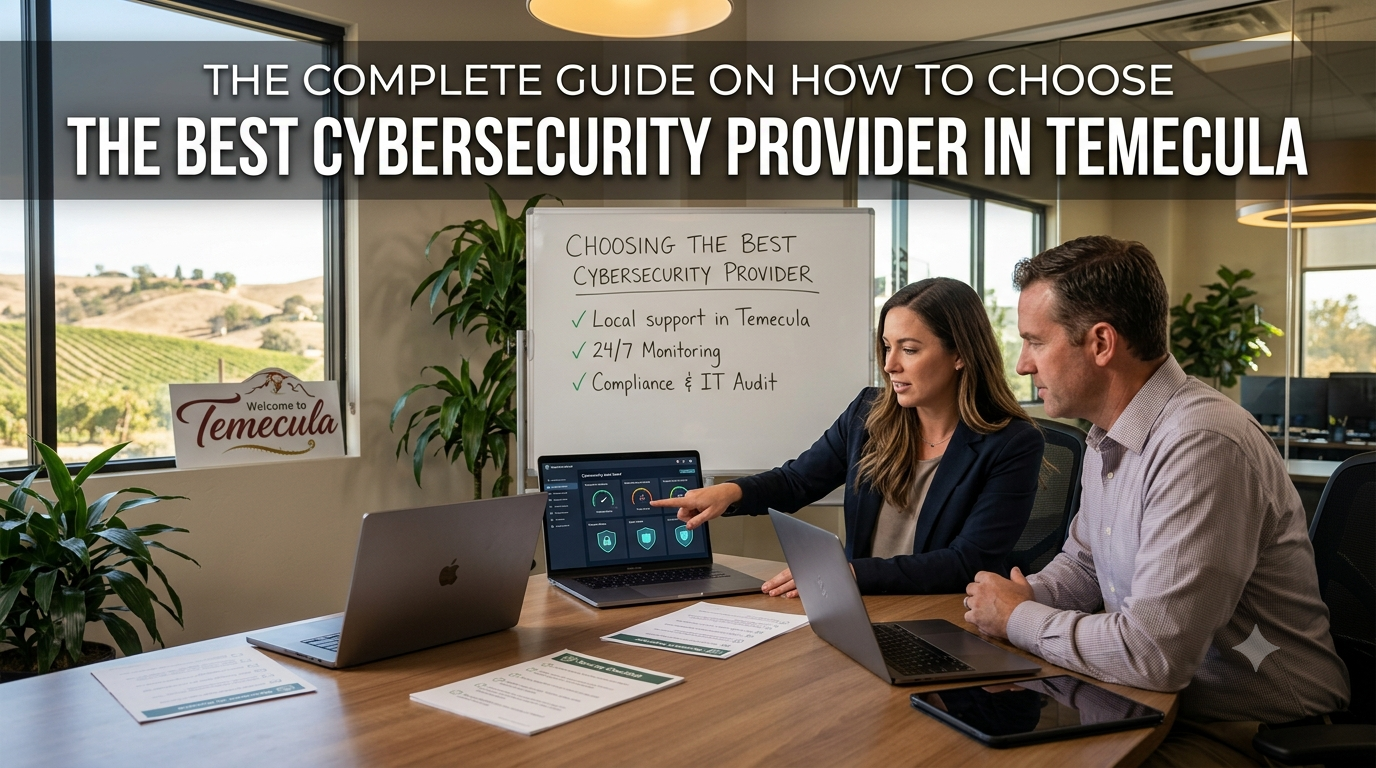
This guide explains the key factors businesses should consider when choosing a cybersecurity provider in Temecula.
Why Cybersecurity Matters for Temecula Businesses
Businesses of all sizes can become targets for cyberattacks. Hackers may target organizations because of valuable customer information, payment data, intellectual property, employee credentials, or simply because a business has vulnerable systems.
Common cybersecurity threats include:
- Phishing and social engineering attacks
- Malware and ransomware
- Business email compromise
- Stolen passwords and credentials
- Data breaches
- Unauthorized network access
- Insider threats
- Website and application vulnerabilities
- Cloud security issues
A successful attack can result in financial losses, operational disruption, reputational damage, and potential regulatory consequences.
For this reason, cybersecurity should not be treated as a one-time technology purchase. It should be viewed as an ongoing business process that includes prevention, monitoring, detection, response, and recovery.
What Does a Cybersecurity Provider Do?
A cybersecurity provider helps organizations identify and reduce digital security risks. Depending on the provider, services can range from basic security assessments to comprehensive managed cybersecurity programs.
Typical services may include:
Security Assessments
A provider can evaluate an organization’s networks, devices, applications, cloud environments, and security practices to identify potential weaknesses.
Network Security
Network security solutions can help protect systems from unauthorized access and suspicious activity through technologies such as firewalls, intrusion detection, secure remote access, and network monitoring.
Endpoint Protection
Employees use laptops, desktops, smartphones, and other devices to access company systems. Endpoint security helps protect these devices against malware, unauthorized applications, and other threats.
Security Monitoring
Continuous monitoring can help identify unusual activity and potential security incidents before they develop into more serious problems.
Vulnerability Management
Regular vulnerability scanning and remediation can help businesses identify outdated software, misconfigurations, and other weaknesses that attackers could exploit.
Incident Response
If a security incident occurs, a cybersecurity provider can help investigate the event, contain the threat, restore affected systems, and reduce the likelihood of similar incidents occurring again.
Employee Security Awareness
Employees are an important part of an organization’s cybersecurity strategy. Security awareness training can help staff recognize phishing emails, suspicious links, social engineering attempts, and other common threats.
1. Understand Your Cybersecurity Requirements
Before comparing cybersecurity providers, determine what your organization actually needs.
Start by asking questions such as:
- What type of information does the business store?
- Which systems are essential for daily operations?
- Do employees work remotely?
- Does the organization use cloud-based applications?
- What types of customer or financial information are collected?
- Are there regulatory or contractual security requirements?
- Does the business already have internal IT staff?
- What cybersecurity protections are currently in place?
A small company may require a very different security strategy from a healthcare organization, financial business, or company handling sensitive customer information.
Understanding your requirements makes it easier to evaluate providers objectively.
2. Look for Relevant Cybersecurity Experience
Experience is one of the most important factors when selecting a cybersecurity provider.
Ask potential providers about their experience working with organizations similar to yours. Industry-specific experience can be particularly valuable because different sectors face different risks and compliance requirements.
For example, a healthcare organization may have different security priorities than a manufacturing company or professional services firm.
You can ask providers:
- How long have you been providing cybersecurity services?
- What industries do you commonly serve?
- What types of security incidents have you handled?
- Do you have experience with businesses of our size?
- Can you provide relevant client references?
The goal is to determine whether the provider understands the practical security challenges your organization faces.
3. Evaluate the Services They Offer
Cybersecurity is a broad field, so it is important to understand exactly what is included in a provider’s service package.
A comprehensive cybersecurity strategy may include:
- Risk assessments
- Vulnerability assessments
- Penetration testing
- Firewall management
- Endpoint security
- Email security
- Identity and access management
- Security monitoring
- Threat detection
- Incident response
- Backup and recovery planning
- Security awareness training
- Compliance assistance
Do not select a provider simply because it offers the largest number of services. Instead, determine whether its services address your organization’s specific security requirements.
4. Ask About 24/7 Monitoring
Cyber threats do not necessarily occur during normal business hours. An attack can happen at night, during weekends, or while employees are away.
Ask whether the provider offers continuous security monitoring and how quickly its team responds to alerts.
Important questions include:
- Is monitoring available 24/7?
- Who investigates security alerts?
- How are critical incidents escalated?
- What is the expected response time?
- Is incident response included in the service?
- Will your organization receive notifications during an incident?
Understanding the provider’s response process before an emergency occurs can prevent confusion when a real security event happens.
5. Examine Their Security Technology
Technology plays an important role in modern cybersecurity, but the most expensive tools are not automatically the best solution for every business.
Ask potential providers which technologies they use and how those technologies work together.
Depending on your environment, useful technologies may include:
- Endpoint detection and response
- Managed detection and response
- Firewalls
- Security information and event management
- Multi-factor authentication
- Vulnerability management platforms
- Email security solutions
- Cloud security tools
- Encryption
- Backup systems
More importantly, ask how the provider uses these tools. A strong cybersecurity program combines technology with skilled security professionals, well-defined processes, and continuous improvement.
6. Check Certifications and Professional Expertise
Cybersecurity professionals can hold industry certifications demonstrating knowledge in different areas of information security.
When evaluating a provider, ask about the qualifications and certifications held by its security team.
Depending on the services required, relevant credentials may include certifications focused on:
- Information security management
- Security auditing
- Penetration testing
- Cloud security
- Risk management
- Incident response
Certifications should not be the only factor in your decision, but they can provide useful evidence of professional training and expertise.
7. Review Their Incident Response Plan
No cybersecurity strategy can guarantee that an organization will never experience an incident. A critical question is how the provider responds when something goes wrong.
Ask the provider to explain its incident response process.
A mature response plan should generally address:
- Detection of suspicious activity
- Initial investigation
- Threat containment
- Removal of malicious activity
- System recovery
- Root-cause analysis
- Post-incident improvements
You should also understand who will be responsible for communication and decision-making during an incident.
8. Consider Compliance and Data Protection
Depending on your industry and operations, your organization may have specific data protection or regulatory obligations.
A cybersecurity provider should be able to explain how its services can support applicable security and compliance requirements.
Ask:
- Which compliance frameworks do you support?
- Can you help with security documentation?
- Do you provide audit assistance?
- How do you protect sensitive information?
- How is customer data stored and accessed?
Be cautious of providers that make broad claims about compliance without explaining what their services actually cover.
9. Understand Pricing and Contract Terms
Cost is naturally an important consideration, but cybersecurity should not be evaluated solely on the lowest monthly price.
When comparing providers, determine exactly what you are paying for.
Review:
- Setup fees
- Monthly service costs
- Monitoring fees
- Licensing costs
- Additional support charges
- Incident response fees
- Contract length
- Cancellation terms
- Hardware or software costs
- Future price increases
Request a detailed proposal so you can compare providers based on comparable services.
The cheapest option may not provide the level of protection your business requires, while the most expensive option may include services that are unnecessary for your environment.
10. Evaluate Communication and Customer Support
Cybersecurity involves more than technology. Communication between your organization and security provider is critical.
A good provider should be able to explain security risks in understandable business terms rather than relying entirely on technical jargon.
Ask how frequently you will receive:
- Security reports
- Vulnerability reports
- Recommendations
- Incident notifications
- Performance updates
You should also know who your primary point of contact will be and how support requests are handled.
11. Ask About Scalability
Your cybersecurity requirements may change as your business grows.
You may eventually add:
- More employees
- New offices
- Cloud applications
- Remote workers
- Additional devices
- New business systems
- New customers
- Additional compliance requirements
Choose a provider that can scale its services as your environment changes.
A cybersecurity partnership should be capable of supporting your organization today while remaining flexible enough for future growth.
12. Request References and Review Reputation
Before signing a long-term agreement, ask potential providers for references from comparable businesses.
When speaking with references, consider asking:
- How responsive is the provider?
- How quickly are security issues addressed?
- Is communication clear?
- Are reports useful?
- Are there unexpected costs?
- Has the provider helped during an actual security incident?
Online reviews can also provide additional context, although they should be considered alongside direct references and your own evaluation.
13. Watch for Warning Signs
While comparing cybersecurity providers, certain warning signs deserve additional attention.
Be cautious if a provider:
- Guarantees that your business can never be hacked
- Cannot clearly explain its security services
- Avoids questions about incident response
- Provides vague pricing
- Has no documented response process
- Cannot provide relevant references
- Uses excessive technical jargon without clear explanations
- Makes unrealistic security promises
- Does not explain how customer data is protected
Cybersecurity is about managing risk, not promising that risk can be completely eliminated.
14. Create a Provider Comparison Checklist
Before making a final decision, create a simple comparison checklist.
Evaluate each provider based on:
| Factor | Questions to Consider |
|---|---|
| Experience | Do they understand your industry and business size? |
| Services | Do they provide the security services you actually need? |
| Monitoring | Is security monitored continuously? |
| Response | What happens when an incident occurs? |
| Technology | Are the tools appropriate for your environment? |
| Expertise | Does the team have relevant professional qualifications? |
| Compliance | Can they support applicable requirements? |
| Pricing | Are costs and contract terms transparent? |
| Support | Is communication responsive and understandable? |
| Scalability | Can the service grow with your organization? |
| References | Can they provide credible client references? |
This approach allows you to compare providers using consistent criteria rather than relying on marketing claims alone.
The Importance of a Long-Term Cybersecurity Strategy
Selecting a cybersecurity provider should not be viewed as simply outsourcing IT security. The right provider can become an important part of your organization’s long-term risk management strategy.
Cybersecurity requires continuous attention because threats, technologies, employees, applications, and business operations change over time.
Regular assessments, security updates, employee training, monitoring, and incident response planning can help organizations maintain stronger security as their digital environment evolves.
Final Thoughts
Choosing the best provider for cybersecurity in Temecula requires careful research and a clear understanding of your organization’s needs. Businesses should look beyond pricing and marketing claims and examine experience, services, monitoring capabilities, incident response, technology, expertise, compliance support, communication, and scalability.
The right cybersecurity provider should work as a long-term security partner, helping your organization identify risks, strengthen defenses, respond to incidents, and adapt to an evolving threat landscape.
By asking the right questions and comparing providers systematically, Temecula businesses can make a more informed decision and build a cybersecurity strategy designed around their actual operational needs.