
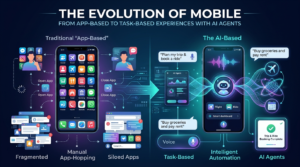
The way people interact with mobile applications is changing rapidly. For years, mobile apps have been built around screens, menus, buttons, and navigation. Users open an application, search for the feature they need, complete several steps, and finally achieve their desired result.
Artificial intelligence is changing this traditional approach.
With the rise of AI agents, mobile applications are gradually moving from app-based experiences to task-based experiences. Instead of requiring users to understand how an application works, AI agents can understand what users want to accomplish and help complete the required steps.
This transformation is creating new opportunities for mobile app developers, businesses, and users.
What Are AI Agents?
AI agents are intelligent software systems designed to understand user requests, reason about tasks, use available tools, and perform actions to achieve specific goals.
Traditional mobile applications typically depend on predefined user journeys:
Open App → Navigate → Select Feature → Enter Information → Confirm → Complete
AI-powered applications can introduce a different interaction model:
Describe Goal → AI Understands Intent → AI Performs Tasks → User Reviews → Result
For example, instead of manually searching through a shopping app, a user could ask:
“Find me a suitable laptop for video editing within my budget.”
An AI agent could understand the request, search relevant products, compare specifications, and present suitable options.
The application becomes less focused on navigation and more focused on completing the user’s objective.
From App-Based to Task-Based Experiences
Traditional apps are generally organized around features.
For example, a banking application might provide separate sections for:
- Account balance
- Money transfer
- Bill payments
- Credit cards
- Transaction history
- Investments
Users must navigate through these features to complete a task.
A task-based experience starts with the user’s goal instead.
Instead of searching through menus, the user might simply say:
“Show me my spending from last month and categorize my expenses.”
The AI agent can interpret the request and connect the user to the appropriate functionality.
This represents a major shift in mobile UX—from feature discovery to goal completion.
How AI Agents Are Changing Mobile App Development
1. Natural Language Becomes a New Interface
One of the biggest changes AI agents bring to mobile applications is natural-language interaction.
Users can communicate with an application using everyday language instead of learning where specific features are located.
For example:
- “Track my latest order.”
- “Find my last payment.”
- “Create a shopping list for this weekend.”
- “Schedule a meeting with my team.”
- “Show me the cheapest available option.”
Developers can combine conversational interfaces with traditional buttons and screens, giving users multiple ways to interact with an application.
2. Applications Can Automate Multi-Step Tasks
Many mobile workflows require users to perform several actions.
Consider booking travel:
- Search for available flights.
- Compare prices and timings.
- Select a flight.
- Enter passenger information.
- Select additional services.
- Review the booking.
- Complete payment.
An AI agent can potentially coordinate multiple steps in this workflow while keeping the user involved at important decision points.
This can reduce unnecessary navigation and make complex processes easier to manage.
3. Mobile Apps Become More Personalized
AI agents can help applications provide more context-aware experiences.
Instead of presenting identical workflows to every user, an AI-powered application can respond based on the user’s request, context, and permitted information.
For example, a fitness application could respond to:
“Create a workout for today based on my available time.”
The application could generate a suitable routine based on information the user has provided and the capabilities available to the system.
Personalization can make applications feel more responsive and useful.
4. Developers Will Build Capabilities, Not Just Screens
Traditional mobile development often focuses heavily on screens and navigation.
With AI agents, developers may increasingly think about the application’s capabilities.
For example, an ecommerce application could expose functions such as:
- Search products
- Check inventory
- Calculate shipping
- Apply discounts
- Create orders
- Track deliveries
An AI agent can use these capabilities to complete tasks based on user intent.
This means APIs, backend services, business logic, and permissions become increasingly important components of the AI-driven mobile experience.
5. User Experience Design Will Evolve
AI-agent applications require more than traditional interface design.
UX designers will need to consider:
- How the AI understands user intent
- How users correct misunderstandings
- When the AI should ask questions
- When confirmation is required
- How users review AI-generated actions
- How users undo completed actions
- How errors are communicated
The experience may combine conversation, visual interfaces, recommendations, confirmations, and automation.
The goal is not necessarily to eliminate traditional UI but to make it available when it is useful.
AI Agents and Mobile App Architecture
AI agents can introduce an additional intelligence layer into mobile applications.
A simplified architecture can look like this:
Mobile App
↓
AI Agent Layer
↓
APIs and Application Tools
↓
Business Logic
↓
Database and External Services
The AI agent interprets the user’s request and determines which approved tools or services are needed to complete the task.
This approach can allow businesses to add AI capabilities to existing applications without completely replacing their existing backend systems.
Security and User Control Are Essential
Greater automation also means greater responsibility.
An AI agent may potentially interact with sensitive information or perform actions on behalf of a user. Developers therefore need to implement appropriate authentication, authorization, data protection, and permission controls.
For sensitive activities such as payments, purchases, account changes, or deletion of important information, applications can require explicit confirmation.
A practical approach is:
AI prepares → User reviews → User confirms → AI executes
This keeps automation useful while maintaining meaningful user control.
Challenges of AI-Powered Mobile Applications
Although AI agents offer significant opportunities, developers also face challenges.
Accuracy and Reliability
AI systems can misunderstand ambiguous instructions or produce incorrect results. Applications need validation mechanisms and appropriate fallback workflows.
Privacy
AI-powered applications may process personal or sensitive information. Developers need to carefully define what information an agent can access and how that information is handled.
Security
Agent permissions should be limited to the actions necessary for a specific task. Developers need safeguards against unauthorized actions and malicious instructions.
User Trust
Users need to understand what an AI agent is doing on their behalf. Clear explanations, confirmations, and activity histories can help users maintain control.
Development Complexity
Building an AI agent involves more than adding a chatbot. Developers may need to integrate AI models with APIs, databases, authentication systems, business rules, monitoring, and application tools.
The Future of Mobile App Development
The future of mobile applications may not be about choosing between traditional interfaces and AI agents.
Instead, successful applications may combine both.
Traditional interfaces are useful when users want precise control, visual information, or quick access to familiar features. AI agents can be valuable when users want to accomplish complex tasks without navigating multiple screens.
This creates a hybrid model:
Traditional UI + Conversational AI + Intelligent Automation + User Control
As AI agents become more capable, mobile applications may increasingly be designed around what users want to accomplish, rather than simply what features an application provides.
Conclusion
AI agents are changing the way developers think about mobile application development.
The traditional model asks users to learn an application’s interface and navigate through its features. The emerging task-based model allows users to describe their goals while the application helps coordinate the steps required to achieve them.
For mobile developers, this shift means focusing not only on screens and interfaces but also on AI orchestration, APIs, application capabilities, security, permissions, context, and user control.
The next generation of mobile applications may not simply be apps that users open and navigate. They may become intelligent systems that users interact with to get things done.
The transition from app-based to task-based experiences is therefore more than a new UI trend—it represents a fundamental change in how people may interact with mobile software.