
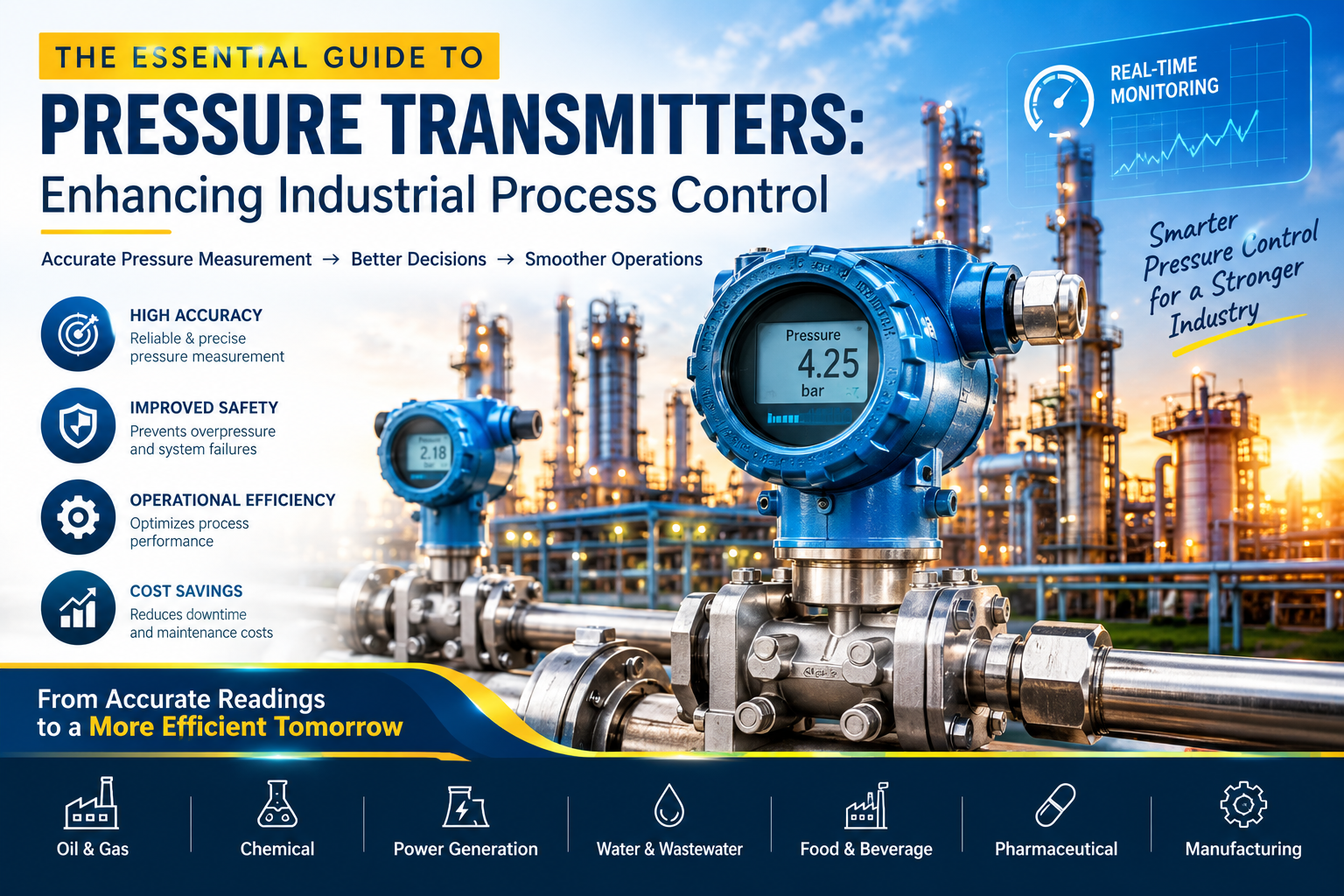
Pressure measurement is one of the most important aspects of industrial process control. Across industries such as oil and gas, chemical processing, pharmaceuticals, power generation, water treatment, and manufacturing, maintaining the correct pressure can directly affect safety, efficiency, product quality, and equipment performance.
This is where pressure transmitters play a critical role.
A pressure transmitter converts pressure from a process into an electrical signal that can be monitored, displayed, recorded, or used by a control system. By providing reliable and continuous pressure information, transmitters help industrial operators make informed decisions and maintain stable process conditions.
This guide explains how pressure transmitters work, their main types, applications, benefits, and the factors businesses should consider when selecting them.
What Is a Pressure Transmitter?
A pressure transmitter is an industrial measuring device that detects pressure and converts it into a standardized output signal.
A typical pressure transmitter includes:
- A pressure-sensing element
- Sensor electronics
- Signal-processing circuitry
- Process connection
- Electrical connection
- Housing
The transmitter measures pressure at a specific point in a process and communicates the measurement to equipment such as a PLC, DCS, SCADA system, display, or industrial monitoring platform.
Unlike a simple pressure gauge, which provides a local visual reading, a transmitter can send pressure information to a remote control or monitoring system.
How Does a Pressure Transmitter Work?
The basic operating process is relatively straightforward.
Process Pressure → Sensing Element → Electrical Signal → Signal Processing → Control System
When pressure is applied to the sensing element, it causes a physical change that the sensor can detect.
Depending on the technology used, this may involve changes in:
- Electrical resistance
- Capacitance
- Piezoelectric properties
- Strain
- Diaphragm position
The transmitter’s electronics convert the sensor response into an output signal representing the measured pressure.
Common industrial output formats include 4–20 mA and digital communication protocols.
Types of Pressure Transmitters
Different industrial processes require different pressure-measurement configurations.
Gauge Pressure Transmitters
Gauge pressure transmitters measure pressure relative to atmospheric pressure.
They are commonly used in applications where the pressure inside a system needs to be compared with the surrounding atmospheric pressure.
Typical applications include:
- Pumps
- Compressors
- Water systems
- Process equipment
- Industrial machinery
Absolute Pressure Transmitters
Absolute pressure transmitters measure pressure relative to a vacuum reference.
They can be useful in applications where atmospheric-pressure changes could affect the measurement.
Examples include:
- Vacuum systems
- Distillation processes
- Laboratory equipment
- Certain industrial process applications
Differential Pressure Transmitters
Differential pressure transmitters measure the difference between two pressure points.
They are widely used for applications such as:
- Flow measurement
- Filter monitoring
- Level measurement
- Pressure-drop measurement
- Process monitoring
For example, measuring pressure before and after a filter can help determine whether the filter is becoming clogged.
Why Pressure Measurement Matters in Industrial Processes
Pressure is often directly connected to how industrial systems operate.
Incorrect pressure can contribute to:
- Equipment damage
- Process instability
- Product-quality problems
- Energy inefficiency
- Safety risks
- Production interruptions
Continuous pressure monitoring allows operators and control systems to identify changes and respond appropriately.
For example, an unexpected pressure increase could indicate a blockage, while a sudden pressure decrease could indicate a leak or equipment problem.
Applications of Pressure Transmitters
Pressure transmitters are used across many industries.
Oil and Gas
Pressure measurement is important throughout exploration, production, processing, storage, and transportation.
Transmitters can be used to monitor:
- Pipelines
- Pumps
- Separators
- Storage systems
- Processing equipment
Chemical Processing
Chemical plants often require precise monitoring of process conditions.
Pressure transmitters can support monitoring of:
- Reactors
- Vessels
- Pipelines
- Pumps
- Filtration systems
Water and Wastewater
Water-treatment facilities use pressure measurement for applications such as:
- Pump monitoring
- Pipeline management
- Filtration
- Water distribution
- System diagnostics
Pharmaceutical Manufacturing
Pharmaceutical processes often require controlled and repeatable operating conditions.
Pressure transmitters can be used in systems involving:
- Process vessels
- Clean utilities
- Filtration
- Sterile processes
- Controlled manufacturing environments
Power Generation
Pressure measurement plays a role in monitoring steam, water, fuel, and other process systems within power-generation facilities.
Manufacturing
Manufacturing facilities use pressure transmitters in pneumatic systems, hydraulic equipment, compressors, process machinery, and automated production systems.
Key Benefits of Pressure Transmitters
Continuous Monitoring
Transmitters provide continuous pressure measurements that can be integrated into industrial control systems.
Remote Monitoring
Because the measurement can be transmitted electronically, operators do not necessarily need to inspect equipment physically to obtain pressure information.
Process Automation
Pressure measurements can be used as inputs for automated control loops.
For example, a control system can adjust a valve or pump based on measured process pressure.
Improved Process Stability
Consistent pressure monitoring helps operators identify deviations and maintain desired operating conditions.
Early Fault Detection
Unexpected pressure changes can provide an early indication of potential equipment or process problems.
Pressure Transmitters in Process Automation
One of the most important applications of pressure transmitters is their integration with automated control systems.
A simplified control loop may look like:
Pressure Transmitter → PLC/DCS → Controller → Control Valve/Pump → Process
The transmitter measures the process condition.
The control system compares the measurement with the desired setpoint.
The controller then determines whether an adjustment is required.
This creates a feedback loop that can help maintain stable process conditions.
Important Specifications to Consider
Selecting a pressure transmitter requires more than simply choosing the correct pressure range.
Important specifications can include:
Pressure Range
The transmitter should be suitable for the expected operating pressure and relevant process conditions.
Accuracy
Accuracy requirements depend on the application and the consequences of measurement error.
Process Connection
The connection must be compatible with the process equipment and installation requirements.
Output Signal
Common options include analog outputs such as 4–20 mA and digital communication interfaces.
Temperature Range
The transmitter should operate reliably within the expected ambient and process-temperature conditions.
Materials
Wetted materials should be compatible with the process media to reduce corrosion and material degradation.
Environmental Protection
Industrial installations may require protection against moisture, dust, vibration, chemicals, or other environmental conditions.
Calibration Requirements
Regular calibration or verification may be necessary depending on the application, regulations, quality requirements, and manufacturer’s recommendations.
Installation Best Practices
Correct installation is essential for reliable pressure measurement.
Important considerations include:
- Selecting an appropriate installation location
- Using compatible process connections
- Avoiding unnecessary vibration
- Protecting the transmitter from unsuitable temperatures
- Ensuring proper electrical connections
- Following manufacturer installation instructions
- Considering impulse-line design for applicable differential-pressure installations
Poor installation can cause measurement errors even when the transmitter itself is functioning correctly.
Maintenance and Calibration
Pressure transmitters are generally designed for industrial environments, but maintenance remains important.
A maintenance program can include:
- Visual inspections
- Checking electrical connections
- Inspecting process connections
- Monitoring measurement trends
- Checking for leaks
- Calibration or verification
- Reviewing diagnostic information
The appropriate maintenance frequency depends on the application, operating environment, equipment requirements, and applicable standards.
The Role of Smart Pressure Transmitters
Modern pressure transmitters can offer more than a basic pressure measurement.
Smart devices may provide features such as:
- Digital communication
- Diagnostic information
- Configuration capabilities
- Sensor-status monitoring
- Measurement history or additional process information
- Remote device management
These capabilities can support predictive maintenance and improve visibility into industrial instrumentation.
Pressure Transmitters and Predictive Maintenance
Pressure trends can provide valuable information about equipment health.
For example, gradual changes in pressure across a filter may indicate increasing restriction.
Similarly, unusual pressure fluctuations may indicate changes in pumps, valves, pipelines, or other equipment.
When pressure data is combined with other process measurements, maintenance teams can potentially identify developing problems earlier and schedule maintenance before a failure causes significant downtime.
Choosing the Right Pressure Transmitter
When selecting a pressure transmitter, businesses should evaluate the complete application rather than choosing based only on price.
Consider:
- What type of pressure needs to be measured?
- What is the expected pressure range?
- What process medium will the transmitter contact?
- What accuracy is required?
- What temperatures will it experience?
- What output and communication protocol are required?
- What environmental conditions exist at the installation site?
- What certifications or industry requirements apply?
- What calibration and maintenance procedures are required?
- Is future integration with automation or monitoring systems important?
Answering these questions can help ensure the selected transmitter is appropriate for the application.
The Future of Pressure Measurement
Industrial measurement is becoming increasingly connected.
As factories adopt industrial automation, IIoT technologies, advanced analytics, and predictive-maintenance strategies, pressure transmitters can become important sources of real-time process data.
Future industrial systems are likely to place greater emphasis on:
- Connected instrumentation
- Remote diagnostics
- Real-time monitoring
- Predictive maintenance
- Data integration
- Automated process optimization
Pressure measurement will remain an essential part of this industrial ecosystem.
Conclusion
Pressure transmitters are fundamental components of modern industrial process control.
By converting process pressure into useful electrical or digital signals, they allow operators and control systems to monitor conditions, automate processes, identify abnormalities, and maintain operational stability.
From oil and gas facilities to pharmaceutical plants, water-treatment systems, power plants, and manufacturing facilities, the right pressure transmitter can contribute to reliable measurement and efficient process management.
Selecting the appropriate device requires careful consideration of pressure range, accuracy, process compatibility, environmental conditions, output requirements, installation, and maintenance.
As industrial automation and connected technologies continue to evolve, pressure transmitters will remain an important link between the physical process and the digital control system.